
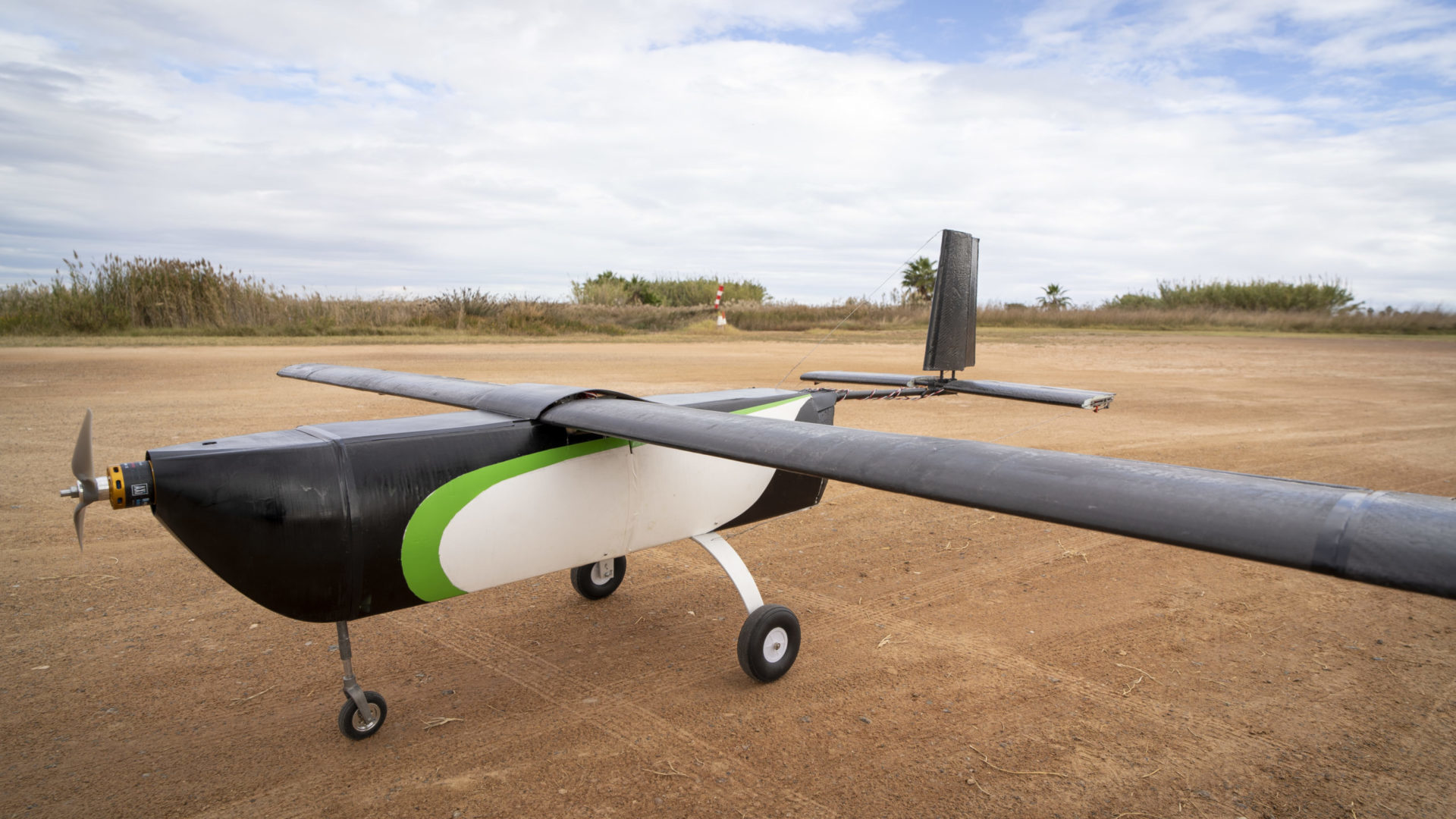
Header Image - Hydrone Project

admin

Feasibility study of a fuel cell-powered unmanned aerial vehicle with 75 kg of payload

by admin

Conference Aerospace Europe Conference 2021

Systems electrification in the unmanned aerial vehicle (UAV) and short-range aircraft industries is a trend that is becoming consolidated as the foundation for the future of this part of the aerospace sector. Among the possible electric powerplants currently driving low-payload UAVs (up to around 10 kg of payload), batteries offer clear benefits with respect to other powerplants due to their compactness, light weight, and flexible operations in distributed propulsion systems when low energy capacity is required. Nonetheless, for medium-payload UAV/aircraft operation such as aerotaxis and heavy-cargo transportation UAVs, the requirements in terms of battery capacity to achieve acceptable range and endurance restrict their usage due to the high weight and volume they imply. In light of this situation, fuel cell (FC) systems (FCS) offer clear benefits over batteries for the medium-payload UAV segment (>50 kg), as their energy density is higher. They also have potential advantages over internal combustion engines, as they operate without pollutant emissions and are more compatible with distributed propulsion systems. Nevertheless, the studies in the literature regarding the application of FCS powerplants to this UAV segment are limited and the in-flight performance has not been clearly analyzed. In order to address this knowledge gap, a feasibility analysis of these particular applications powered by FCS is performed in this study. For that purpose, a validated FC stack model (40 kW of maximum power) was integrated into a balance of plant to conform an FCS. As a novelty, the management of the FCS was optimized to maximize the FCS efficiency at different altitudes up to 12500 ft, so that the operation always implies the lowest H 2 consumption regardless of the altitude. In parallel, an UAV numerical model was developed based on the ATLANTE vehicle and characterized by calculating the aerodynamic coefficients through CFD simulations. Then, both models were integrated into a 0D-1D modelling platform together with an energy management strategy optimizer algorithm and a suitable propeller model. With the preliminary results obtained from the FCS and UAV models, it was possible to ascertain the range and endurance of the vehicle. As a result, it was concluded that the combination of both technologies could offer a range over 600 km and an endurance over 5 h. Finally, with the integrated UAV-FCS model, a flight profile describing a medium altitude, medium endurance mission was designed and used to analyze the viability of FC-powered UAV. The results showed how UAVs powered by FCS are viable for the considered aircraft segment, providing competitive values of specific range and endurance (View Full-Text).

Series-hybridisation, distributed electric propulsion and boundary layer ingestion in long-endurance, small remotely piloted aircraft: Fuel consumption improvements

by admin

Journal Aerospace Science and Technology – https://doi.org/10.1016/j.ast.2021.107227

Series hybridisation, distributed electric propulsion (DEP) and boundary layer ingestion (BLI) are some of the most promising approaches for fuel consumption reductions in general aviation and commercial air transport. While these technologies can be also adapted for long endurance and long range, propeller-driven, small remotely piloted aircraft, their beneficial effects are not so clear due to the relatively high increase in propulsion system weight and the reduction in efficiency of the lower Reynolds number propellers. Using weights and efficiencies of off-the-shelf components, this work studies the impact of series hybridisation with and without DEP and BLI in a long endurance, 25 kg of maximum takeoff mass fixed wing aircraft, showing promising results with fuel consumption reductions of more than 15% (View Full-Text).

Propeller Position Effects over the Pressure and Friction Coefficients over the Wing of an UAV with Distributed Electric Propulsion: A Proper Orthogonal Decomposition Analysis

by admin

Journas Drones – https://doi.org/10.3390/drones6020038

New propulsive architectures, with high interactions with the aerodynamic performance of the platform, are an attractive option for reducing the power consumption, increasing the resilience, reducing the noise and improving the handling of fixed-wing unmanned air vehicles. Distributed electric propulsion with boundary layer ingestion over the wing introduces extra complexity to the design of these systems, and extensive simulation and experimental campaigns are needed to fully understand the flow behaviour around the aircraft. This work studies the effect of different combinations of propeller positions and angles of attack over the pressure coefficient and skin friction coefficient distributions over the wing of a 25 kg fixed-wing remotely piloted aircraft. To get more information about the main trends, a proper orthogonal decomposition of the coefficient distributions is performed, which may be even used to interpolate the results to non-simulated combinations, giving more information than an interpolation of the main aerodynamic coefficients such as the lift, drag or pitching moment coefficients (View Full-Text)

Computational Study of the Propeller Position Effects in Wing-Mounted, Distributed Electric Propulsion with Boundary Layer Ingestion in a 25 kg Remotely Piloted Aircraft

by admin

Journal Drones –  https://doi.org/10.3390/drones5030056

Distributed electric propulsion and boundary layer ingestion are two attractive technologies to reduce the power consumption of fixed wing aircraft. Through careful distribution of the propulsive system elements, higher aerodynamic and propulsive efficiency can be achieved, as well as a lower risk of total loss of aircraft due to foreign object damage. When used on the wing, further reductions of the bending moment on the wing root can even lead to reductions of its structural weight, thus mitigating the expected increase of operating empty weight due to the extra components needed. While coupling these technologies in fixed-wing aircraft is being actively studied in the big aircraft segment, it is also an interesting approach for increasing the efficiency even for aircraft with maximum take-off masses as low as 25 kg, such as the A3 open subcategory for civil drones from EASA. This paper studies the effect of changing the propellers’ position in the aerodynamic performance parameters of a distributed electric propulsion with boundary layer ingestion system in a 25 kg fixed-wing aircraft, as well as in the performance of the propellers. The computational results show the trade-offs between the aerodynamic efficiency and the propeller efficiency when the vertical position is varied (View Full-Text).